

A New Copper Superpower Is Emerging in the Andes: Why Argentina and Chile Could Reshape Global Supply

Introduction
The global copper race may be entering a new phase.
For decades, Chile has stood at the centre of global copper production.
Across the Andes, however, Argentina possesses enormous undeveloped copper resources that have struggled to reach their full potential.
Now the two countries are moving closer together.
Argentina and Chile are advancing cross-border mining cooperation designed to make it easier for major projects in the Andes to share infrastructure, logistics and access to international markets.
The implications could be enormous.
For mining companies, investors, exploration contractors and drilling companies, the Andes could become one of the most important exploration and mine-development regions in the world.
And at the centre of everything is the metal the modern economy increasingly cannot function without:
Copper.
The World Needs More Copper
Copper has always been an important industrial metal.
But the global energy and technology transition has transformed its strategic importance.
Copper is required for:
Artificial intelligence data centres
National electricity grids
Electric vehicles
Renewable energy
Battery storage
Construction
Telecommunications
Defence
Industrial manufacturing
The challenge is that demand can increase considerably faster than new mines can be developed.
A new data centre can be constructed relatively quickly.
A major new copper mine cannot.
Finding, defining, permitting, financing and constructing a world-class copper operation can take many years.
That makes regions containing large undeveloped copper resources increasingly important.
The Andes Are One of Earth's Great Copper Regions
The Andes contain some of the world's most extraordinary copper geology.
Chile has already demonstrated what that geology can produce.
Its enormous porphyry copper systems have supported world-class mines and helped establish the country as a global mining powerhouse.
But the same geological belt does not stop at a national border.
It continues into Argentina.
And that is where the story becomes particularly interesting.
Argentina contains major copper projects capable of becoming increasingly important to future global supply.
For years, however, geography and infrastructure have complicated development.
Many Argentine copper projects sit high in the Andes.
Chile, meanwhile, has decades of mining infrastructure and established access to Pacific export markets.
Greater cooperation between the two countries could begin changing the economics.
Mining Does Not Care About Borders — Logistics Does
Geology does not follow political boundaries.
Mineral systems can extend across mountains, provinces and international borders.
Mining infrastructure, however, is normally developed within individual countries.
That can create inefficiencies.
A project may sit geographically closer to a port, road, power network or processing facility located across an international border than infrastructure within its own country.
Cross-border cooperation can potentially allow mining projects to use the infrastructure that makes the most economic sense.
For remote Andean copper projects, that matters.
Because building a mine is not simply about extracting ore.
It requires:
Roads
Electricity
Water
Processing facilities
Fuel
Equipment
Workforce logistics
Concentrate transportation
Export infrastructure
Reducing any of those costs can materially influence project economics.
Argentina Could Become a Major Copper Producer
Argentina is already globally recognised for lithium.
But copper could become another major chapter in the country's mining story.
The country hosts several large undeveloped copper systems.
If major projects progress into production, Argentina could emerge as an increasingly important copper-producing jurisdiction.
That would have implications far beyond South America.
The world is actively searching for new sources of copper.
Governments want diversified mineral supply chains.
Technology companies need electrical infrastructure.
Automakers need copper.
Renewable energy developers need copper.
Power grids need copper.
Argentina has the geology.
The challenge is converting that geology into operating mines.
Chile Has Something Argentina Needs: Infrastructure
Chile has spent decades building a sophisticated mining economy.
The country possesses:
Experienced mining workforces
Established suppliers
Mining engineering expertise
Roads and transport networks
Processing infrastructure
Pacific ports
International mining investment
Argentina possesses enormous geological potential on the other side of the Andes.
Connecting those strengths creates an obvious opportunity.
Rather than viewing the border purely as a barrier, mining companies can increasingly view the region as one interconnected geological and logistical system.
That could fundamentally change how some Andean projects are developed.
Exploration Comes First
Before billions can be committed to mine construction, companies must understand what is actually beneath the mountains.
That requires exploration.
Geologists can use:
Geological mapping
Geochemical sampling
Magnetic surveys
Induced polarisation
Satellite data
Structural interpretation
Three-dimensional geological modelling
These technologies can identify promising targets.
But eventually every geological model faces the same test:
The drill bit.

Diamond Drilling Will Be Critical
Large porphyry copper systems require enormous amounts of geological information.
Diamond drilling provides continuous rock core that allows geologists to examine the mineral system beneath the surface.
Core can reveal:
Copper mineralisation
Alteration
Veining
Geological structure
Rock quality
Fault zones
Deposit continuity
As exploration targets become deeper, drilling programs can become increasingly demanding.
A successful drilling contractor therefore needs much more than a machine capable of rotating drill rods.
Equipment reliability, drilling fluids, hole stability, experienced crews and mechanical support all become critical.
Drilling the Andes Is Not Easy
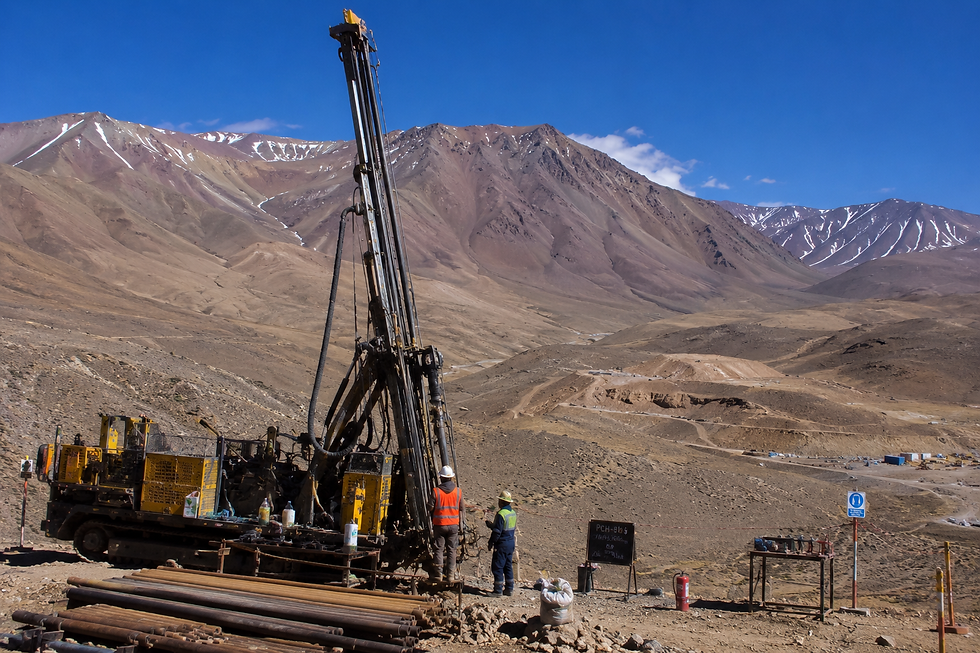
Some of the world's greatest mineral deposits are located in some of the world's most difficult operating environments.
Andean exploration can involve:
Extreme altitude
Steep terrain
Cold temperatures
Strong winds
Remote access
Long supply chains
Limited water availability
These conditions affect both personnel and equipment.
Engines behave differently at altitude.
Hydraulic systems work under demanding conditions.
Crews need appropriate rotation and acclimatisation.
Fuel, rods, drilling muds and spare parts need to be transported into remote locations.
Every logistical decision matters.
Remote Exploration Is an Entire Operating System
A common mistake in exploration is focusing exclusively on the drill rig.
The rig is only one part of the operation.
To keep drilling, a project also needs:
Drill rods
Core barrels
Bits
Drilling muds
Pumps
Fuel
Water
Spare parts
Mechanical support
Experienced drillers
Offsiders
Supervisors
If one critical component is missing, the entire operation can stop.
This is particularly expensive in remote environments.
A small spare part costing relatively little can potentially prevent days of lost production.
For that reason, critical-spares planning should be treated as part of exploration strategy—not an afterthought.

Productivity Is About More Than Metres Per Day
Mining companies naturally monitor drilling production.
Metres matter.
But metres alone do not tell the entire story.
A successful exploration drilling programme should consider:
Core recovery
Hole condition
Equipment utilisation
Safety
Downtime
Consumable usage
Maintenance
Geological objectives
Pushing a rig aggressively simply to achieve a daily metre target can sometimes create larger problems.
The objective should always be sustainable production while protecting the hole, the equipment and the geological information being recovered.
The Next Generation of Copper Mines Will Require Experienced Drilling Teams
As copper exploration moves deeper and into increasingly remote terrain, experienced personnel become even more important.
Ground conditions can change rapidly.
Drillers may encounter:
Broken formations
Clay
Fractured rock
Water loss
High water inflows
Cavities
Unstable formations
Experienced crews know when to push production and when to protect the hole.
That judgement cannot always be automated.
CED's Approach to Exploration
At Cylinder Exploration Drilling (CED), we increasingly view exploration drilling as a complete system.
Our capabilities extend beyond manufacturing drill rigs.
CED can support projects with:
Diamond drilling rigs
Reverse circulation drilling rigs
Air core drilling rigs
Compressors
Drilling consumables
Drilling muds
Critical spare parts
Experienced drillers
Mechanical fitters
Supervisors
Operational management
For remote exploration programmes, having equipment and personnel working as one integrated operation can significantly reduce complexity.
Why This Matters Beyond Argentina and Chile
The Argentina-Chile story represents something larger happening across global mining.
Countries are beginning to realise that mineral supply chains cannot always be developed in isolation.
Mining projects increasingly depend on regional cooperation.
Africa has cross-border mineral belts.
Central Asia has enormous mineral systems spanning multiple countries.
Southeast Asia contains interconnected nickel and copper supply chains.
The Middle East is positioning itself as a mineral processing and investment hub.
Mining is becoming increasingly international.
The countries capable of cooperating around infrastructure, exploration and investment could gain a major competitive advantage.
Copper Is Becoming Geopolitical
Copper was once viewed primarily as an industrial commodity.
That is changing.
Electricity security is national security.
Data infrastructure is national security.
Manufacturing capacity is national security.
And all of them depend on raw materials.
This means large undeveloped copper deposits are becoming strategically important assets.
Countries capable of bringing those deposits into production will have increasing influence over future global supply chains.
The Race Starts Underground
Governments can sign agreements.
Investors can provide capital.
Companies can announce billion-dollar projects.
But none of those things change the geology.
Ultimately, every project still has to prove what exists beneath the ground.
That requires drilling.
Thousands of metres.
Sometimes tens of thousands.
And eventually hundreds of thousands of metres across major mining districts.
The companies capable of drilling safely, efficiently and consistently in difficult environments will therefore remain fundamental to the next global copper cycle.
Final Thought
The Andes have already produced some of the greatest copper mines the world has ever seen.
They may not be finished.
Greater cooperation between Argentina and Chile could help unlock another generation of enormous copper projects along one of the most mineral-rich geological belts on Earth.
Argentina brings major undeveloped resources.
Chile brings decades of mining infrastructure and access to Pacific markets.
Together, they could create something far more powerful:
A new Andean copper corridor.
The world needs more copper.
The geology exists.
The investment is arriving.
The infrastructure is connecting.
Now the exploration industry has to prove what is underground.
Because before the next great copper mine crosses the Andes—
the drill bit has to get there first.


Comments