

Guyana’s Gold Rush Is Back: Why the Next Big Discovery Needs More Than a Drill Rig

Guyana is getting serious about gold.
Not just the gold sitting in rivers and alluvial deposits.
Not just the gold coming out of established mines.
The real opportunity lies deeper underground, where exploration companies are testing mineral systems that could support the next generation of large-scale gold projects.
And September has delivered another reminder that Guyana's gold sector is moving.
On 10 September 2026, the Guyanese government announced a mineral agreement for Mako Mining's Eagle Mountain Gold Project. The agreement establishes a framework for the project's development, with construction currently anticipated in 2027 and production targeted for the end of 2028, subject to the required approvals.
Ministry of Natural Resources (MNR)
Meanwhile, Omai Gold Mines reported new diamond drilling results from its Wenot deposit, including an intersection of 5.12 grams per tonne of gold over 40.5 metres. The company reported five rigs working on its 2026 drilling programme.
These are two different stages of the same mining story.
One project is moving toward construction.
Another is drilling to better understand and expand its mineral resource.
Both demonstrate an important point.
Before Guyana can build its next generation of gold mines, somebody has to prove what is actually underground.
And in the middle of a tropical rainforest, that is not always as straightforward as it sounds.

1. Why Guyana Is Back on the Gold Exploration Map
Guyana has a long history of gold mining.
But its modern gold sector is not simply a continuation of the past.
The country has several substantial projects at different stages of exploration and development.
In its 2026 budget, the Guyanese government highlighted progress at Aurora, Oko West, Oko, Toroparu and Omai. It also identified the expansion of large-scale gold mining as an important part of the country's economic development beyond oil.
Finance Ministry of Guyana.
That creates opportunities across the mining supply chain.
Exploration companies need geological information.
Development projects need additional drilling.
Contractors need equipment.
Operations need trained personnel.
And remote projects need logistics systems capable of keeping everything moving.
But here is the interesting part.
A gold project does not become a mine because somebody finds gold.
It becomes a potential mine when exploration establishes enough reliable geological, technical and economic information to justify further investment.
That takes drilling.
Often, a considerable amount of it.
2. Omai: Why an Old Gold Mine Can Still Have a New Exploration Story
One of Guyana's most interesting examples is Omai.
The historical Omai mine produced more than 3.7 million ounces of gold between 1993 and 2005, according to Omai Gold Mines. The company is now investigating the remaining and additional potential of the Wenot and Gilt deposits.
Omai Gold Mines Corp.
In September 2026, Omai reported further drilling results from Wenot as part of its 50,000-metre programme.
The company said its drilling was testing the deposit's boundaries, investigating additional mineralised zones and gathering information to support resource development.
This is why brownfield exploration can be so interesting.
An old mine is not necessarily the end of the geological story.
Previous operators may have concentrated on the mineralisation that was economically attractive at the time.
Deeper targets may not have been fully tested.
Adjacent structures may remain poorly understood.
New geological models may identify areas worth investigating.
And modern drilling can provide information that earlier exploration programmes never collected.
Of course, additional mineralisation does not automatically mean an economically viable mine.
That is precisely why exploration exists.
The drill bit tests the theory. The core provides the evidence.
3. Guyana's Jungle Is Not Particularly Interested in Your Drilling Schedule
Here is where the story becomes considerably more interesting for anyone who has actually operated a drilling programme.
Guyana's interior presents very different conditions from an established mining district with paved roads, workshops and suppliers around the corner.
Depending on the project location, exploration teams may face tropical rainfall, soft access tracks, dense vegetation, river crossings, limited infrastructure and lengthy supply routes.
A drilling programme might look perfectly straightforward on a geological map.
Then somebody tries to move the equipment.
Suddenly, the programme needs answers to a completely different set of questions.
How do we get the rig to the pad?
Can the access road support the equipment?
Where is the water coming from?
How are the drill rods being transported?
Where will the crew stay?
How quickly can a replacement hydraulic component reach the site?
And what happens when heavy rain turns yesterday's access track into tomorrow's problem?
In remote exploration, the geology chooses the location. The drilling operation has to adapt.
That is why equipment selection needs to begin with the actual operating environment, not simply the maximum drilling depth printed on a specification sheet.

4. Diamond Drilling: Turning Gold Targets Into Geological Evidence
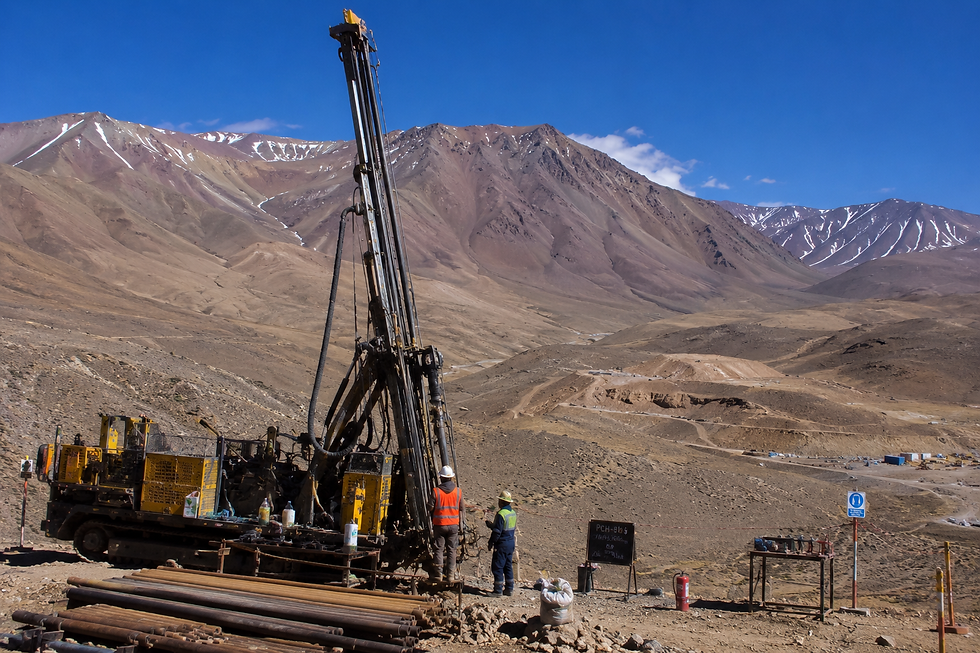
Diamond drilling is fundamental to many hard-rock gold exploration programmes.
The reason is simple.
It provides continuous rock core.
A geologist can examine the physical relationship between mineralisation, host rock, alteration, veining and geological structures.
That information helps exploration teams understand not only whether gold is present, but how mineralisation may be distributed underground.
For example, diamond core can help geologists investigate:
The orientation and continuity of mineralised structures.
Changes in rock type and alteration.
Quartz veining and associated mineralisation.
Fractures, faults and ground conditions.
The relationship between different mineralised zones.
Rock quality and geotechnical characteristics.
Samples can then be prepared and sent for laboratory analysis.
The results help refine the geological model and determine where the next holes should be drilled.
One hole may confirm a target.
Another may change the interpretation completely.
A third may demonstrate that the original theory was wrong.
That is not necessarily a failed exploration programme.
That is exploration doing its job.
5. RC and Air Core: Finding Out Where to Drill Next
Diamond drilling is not always the first method a project needs.
For large exploration licences, the initial challenge may be identifying which targets deserve more detailed investigation.
This is where Air Core and Reverse Circulation drilling can become valuable.
Air Core drilling
In suitable shallow, relatively unconsolidated formations, Air Core drilling can help exploration teams collect samples beneath surface cover and investigate geochemical patterns across a broad area.
It is particularly useful where the programme requires systematic shallow testing rather than immediate deep drilling.
However, its suitability depends on ground conditions, target depth and the sampling requirements.
Reverse Circulation drilling
RC drilling can provide a productive method of testing appropriate hard-rock targets and collecting rock-chip samples.
It may be used to investigate mineralised structures, follow up geochemical anomalies or test targets before a more detailed diamond drilling programme.
The important point is that the drilling method should follow the geological objective.
Not every target needs the same rig.
Not every project needs the same drill string.
And not every stage of exploration requires the same level of geological information.
A properly designed programme uses the right method at the right time.
6. The Hidden Cost of Remote Gold Exploration: Downtime
A drilling rig can be a substantial investment.
But the cost of an unexpected breakdown extends well beyond the machine itself.
Imagine a remote exploration camp in Guyana.
The rig is mobilised.
The drill crew is on site.
The geological team is ready.
Fuel, accommodation, transport and support services are already being paid for.
Then a relatively small mechanical component fails.
The replacement is not on site.
Now the entire programme is waiting for a part.
It might need to be sourced internationally.
It might need to clear customs.
It might need to travel by road, river or aircraft before it reaches the drill pad.
A component that costs a few hundred dollars can create a much larger operational problem.
This is why critical-spares planning matters so much.
The correct question is not simply:
Which parts are most expensive?
It is:
Which parts could stop the entire drilling programme if they fail?
Those components deserve particular attention during mobilisation planning.
7. A Complete Drilling Package Beats a Lonely Rig in the Jungle
At CED, we believe one of the biggest mistakes in exploration procurement is treating the drill rig as the entire drilling solution.
It is not.
A successful programme needs a system that works together.
That may include the rig, mud pumps, compressors, drill rods, core barrels, bits, casings, drilling fluids, generators, water pumps, critical spares and support equipment.
Then there are the people.
Drillers.
Offsiders.
Mechanical fitters.
Supervisors.
Logistics personnel.
The right equipment without the right personnel can become an expensive problem.
The right personnel without the right equipment and consumables face exactly the same issue.
The objective is not to get a drill rig into Guyana. The objective is to keep it drilling safely and productively once it gets there.
That requires planning long before the first hole begins.
8. The Case for Compact, Track-Mounted and Man-Portable Rigs
Remote exploration programmes should consider access requirements before selecting equipment.
A larger machine may offer greater drilling capacity, but its weight, footprint and transport requirements can create limitations.
A compact track-mounted rig may provide better access across certain soft or uneven sites.
A modular man-portable drilling system may be appropriate where equipment needs to be moved in smaller loads.
For particularly inaccessible targets, a heli-portable system may be worth evaluating, provided the project has suitable aviation support, lifting arrangements and operating conditions.
The correct choice depends on the planned hole depths, drilling method, geology, terrain and available infrastructure.
There is no universal solution.
A rig that performs exceptionally well on one project may be completely unsuitable for another.
And a smaller rig is not automatically the right answer simply because a project is remote.
The equipment has to match both the ground beneath the drill pad and the journey required to reach it.
9. Water, Drilling Fluids and Hole Stability: The Less Glamorous Side of Finding Gold
Gold exploration articles tend to focus on impressive assay results.
Fair enough.
That is what attracts attention.
But anyone who has spent time on a diamond drilling programme knows that the geological conditions between the surface and the target can be just as important as the target itself.
Broken formations can collapse.
Clay-rich intervals can create problems.
Water losses can complicate circulation.
Unstable ground can make rod retrieval difficult.
The deeper a hole becomes, the more costly it may be to lose it.
This is why drilling fluids, casing strategies, equipment capacity and experienced drilling personnel are important.
Sometimes the correct operational decision is to slow down.
Sometimes the hole needs stabilising.
Sometimes additional casing is required.
The aim is not simply to produce the largest possible number of metres during a shift.
It is to reach the geological objective while maintaining hole integrity, sample quality and safe operating conditions.
A completed hole that delivers usable geological information is worth considerably more than an impressive daily metre count followed by a lost hole.
10. Environmental Responsibility Is Part of the Exploration Plan
Guyana's forested environments also make responsible exploration planning essential.
Drill-pad preparation, access routes, water use, fuel storage, waste management and rehabilitation all need to be considered.
Exploration teams should plan for appropriate containment, minimise unnecessary disturbance and work within applicable permits and environmental requirements.
Guyana's Environmental Protection Agency maintains environmental assessment documents for major mining projects, while the Guyana Geology and Mines Commission administers mineral-property applications and related licensing processes.
Environmental Protection Agency
Responsible exploration is not separate from good operational planning.
It is part of it.
Poorly planned access, uncontrolled waste or inadequate water management can create problems for communities, the environment and the project itself.
A successful drilling programme needs to deliver useful geological information while managing its impact on the surrounding area.
11. CED: Exploration Equipment, Crews and Support for Remote Gold Projects
At Cylinder Exploration Drilling, our focus is on the complete exploration operation.
We manufacture and supply drilling equipment while also providing experienced personnel and drilling programme support.
For gold exploration projects in Guyana and across South America, CED can discuss solutions involving:
Diamond core drilling rigs, including compact and remote-access configurations.
RC and Air Core drilling equipment for suitable exploration programmes.
Mud pumps, air compressors and supporting equipment.
Drill rods, core barrels, bits, casings and consumables.
Drilling fluids and critical spare-parts packages.
Experienced drillers, mechanical fitters and supervisors.
Mobilisation planning, commissioning, training and operational support.
We can also discuss client-owned equipment models in which the exploration company purchases its drilling assets and CED provides the personnel and operational management needed to run the programme.
That approach can give a client ownership of its equipment while retaining access to specialist drilling expertise.
But the right structure depends on the project.
A short reconnaissance programme does not need the same operating model as a multi-rig, multi-year resource-definition campaign.
The first conversation should be about the geological objectives, access conditions, drilling requirements and project timeline.
The equipment package comes after that.

12. Guyana's Next Gold Discovery Will Be an Operational Achievement Too
The renewed activity around Eagle Mountain and Omai illustrates the different stages of Guyana's gold sector.
One project is establishing a pathway toward development.
Another is generating additional geological information through an active drilling programme.
Ministry of Natural Resources (MNR)
Elsewhere, exploration teams will continue examining targets, collecting samples and deciding where to drill next.
Some targets will disappoint.
Some will justify further investigation.
And some may eventually support new mineral resources and future mining projects.
But none of that happens through geological potential alone.
It takes investment.
It takes people.
It takes equipment.
It takes logistics.
And in remote environments, it takes an operating plan that can survive considerably more than a perfect day on a perfect drill pad.
Because finding gold in Guyana's jungle is only half the battle.
Getting the equipment there, keeping it running and bringing back the geological evidence is the other half.
The question
As Guyana's gold exploration sector develops, what do you think will be the biggest challenge for the next generation of remote drilling programmes: access, experienced personnel, equipment reliability or logistics?


Comments