

Man-Portable & Heli-Portable Diamond Drilling Rigs: From 100m to 2,000m NQ

NO ROAD? THAT SHOULDN'T MEAN NO DRILLING.
Some of the world's most interesting mineral exploration targets are nowhere near a road.
They're across mountains.
Deep in jungle.
Beyond rivers.
On steep terrain.
Inside remote exploration licences where getting a conventional drill rig to the target can become almost as complicated as drilling the hole itself.
That is exactly why man-portable and heli-portable diamond drilling rigs exist.
But at CED, heli-portable drilling isn't limited to one small specialist machine.
Our complete Diamond Core drilling range is designed around modularity and remote mobilisation.
From the compact CED100, with capability to drill approximately 100 metres NQ, through to the CED2000, designed for drilling to approximately 2,000 metres NQ, CED offers a range of Diamond Core rigs for exploration programmes where access and drilling depth both matter.
Because sometimes the target is remote.
Sometimes the target is deep.
And sometimes it's both.

What Is a Man-Portable Diamond Drill Rig?
A man-portable diamond drill rig is designed so that the drilling system can be separated into manageable modules for transportation into locations where moving a conventional complete rig is difficult or impossible.
That can mean moving equipment by hand over short distances, using local access methods, transporting modules on small vehicles or combining ground mobilisation with helicopter support.
The principle is straightforward:
Don't force the exploration programme to build infrastructure around the drill rig. Make the drilling equipment adaptable to the exploration programme.
For early-stage and remote mineral exploration, that can fundamentally change which targets are practical to test.
What Is Heli-Portable Diamond Drilling?
Heli-portable diamond drilling uses helicopters to transport drilling equipment, tooling and supporting equipment into remote drill sites.
Instead of constructing substantial access roads to every drill pad, appropriately configured drilling equipment can be broken into transportable modules and moved by helicopter.
This approach can be particularly relevant in:
Mountainous terrain
Tropical exploration projects
Dense jungle
Remote islands
Steep terrain
Areas separated by rivers
Environmentally sensitive exploration areas
Frontier exploration licences
Locations with limited road infrastructure
Helicopter-supported drilling brings its own logistical challenges, but when road access is extremely difficult, the ability to mobilise equipment by air can open exploration targets that would otherwise be extremely expensive or impractical to drill.
HELI-PORTABLE DOESN'T HAVE TO MEAN SHALLOW
This is where CED's approach becomes particularly interesting.
When people hear portable diamond drilling rig, they often picture a small machine designed exclusively for shallow holes.
CED takes a broader approach.
Our Diamond Core range extends from approximately 100 m NQ capability to 2,000 m NQ capability.
That gives exploration companies the ability to select equipment around the actual geological target rather than assuming remote-access drilling must automatically mean shallow drilling.
At one end:
CED100 — compact exploration drilling to approximately 100 m NQ.
At the other:
CED2000 — deep Diamond Core drilling capability to approximately 2,000 m NQ.
Between them sits a complete range of rigs designed for different exploration depths and project requirements.
CED Diamond Drilling Rigs: From 100m to 2,000m NQ
CED manufactures a broad family of Diamond Core drilling rigs:
CED100
The smallest CED Diamond Core rig.
Designed around compact, highly mobile exploration drilling, the CED100 is particularly suited to shallow targets, reconnaissance drilling and early-stage mineral exploration where access is difficult.
NQ capability: approximately 100 m.
For greenfield exploration programmes where the objective is to get geological information quickly without mobilising a large drilling system, the CED100 can make enormous sense.
CED200
The CED200 moves the platform into greater drilling capability while retaining the modular philosophy required for remote exploration.
It provides another option for programmes requiring more capacity than the CED100 without immediately jumping into significantly larger drilling equipment.
CED350
The CED350 continues the progression toward greater drilling depth and capability.
For exploration programmes where initial shallow drilling has identified targets requiring deeper investigation, this intermediate class of rig provides another option while maintaining CED's focus on transportability and remote mobilisation.
CED500
The CED500 takes CED's portable Diamond Core range firmly into deeper mineral exploration.
This type of drilling capability becomes relevant as exploration moves beyond initial reconnaissance and into more substantial geological testing and resource development.
CED750
As drilling programmes become deeper and more demanding, the CED750 provides increased capacity while remaining part of the modular CED Diamond Core family.
This is where remote drilling starts becoming particularly interesting.
You're no longer simply talking about shallow scout drilling.
You're talking about meaningful Diamond Core exploration capability in locations where mobilisation can still be one of the biggest challenges on the project.

CED1000
The CED1000 takes remote-access Diamond Core drilling into serious depth territory.
Designed for substantial exploration programmes, it gives CED another option for projects requiring deeper drilling while maintaining a system that can be configured around challenging mobilisation requirements.
This is the type of equipment that demonstrates an important point:
Remote drilling does not automatically mean small drilling.
CED1500
For deeper exploration targets, the CED1500 pushes the range further again.
Deep Diamond Core programmes require substantially more than raw drilling power.
Rod handling.
Mud management.
Pumps.
Consumables.
Mechanical support.
Drilling experience.
Logistics.
Critical spares.
As the holes become deeper, every part of the drilling system becomes increasingly important.
CED2000
At the top of the range sits the CED2000.
With capability designed around drilling to approximately 2,000 metres NQ, the CED2000 demonstrates just how far the CED modular Diamond Core concept can extend.
This is serious deep exploration drilling capability designed around the same fundamental question that started the range:
How do we get the drilling equipment to the target?
Why Remote Mineral Exploration Needs Portable Drilling Equipment
Mineral exploration is moving into increasingly challenging areas.
Many obvious or easily accessible mineralised systems have already been explored extensively.
New discoveries increasingly require exploration companies to investigate more difficult terrain and frontier jurisdictions.
That means access becomes part of exploration economics.
Imagine discovering an extremely interesting geophysical anomaly.
The geology looks right.
The geochemistry looks right.
The target looks fantastic.
There is just one problem.
There is no road.
A conventional approach may require road construction, earthworks, heavy mobilisation equipment and significant site preparation before drilling even begins.
Depending on the location, a more modular man-portable or heli-portable drilling system can offer another approach.
The objective isn't to eliminate logistics.
Remote drilling will always involve logistics.
The objective is to make those logistics manageable.
Gold Exploration in Remote Terrain
Gold exploration is one obvious application.
Some prospective gold belts occur across mountainous, heavily vegetated or poorly developed terrain.
Early exploration targets may also be widely distributed across a licence.
Building substantial access infrastructure to every speculative target can quickly consume exploration budgets.
A smaller man-portable Diamond Core drill rig can be useful for early-stage targets.
As geological confidence increases and deeper drilling becomes necessary, larger heli-portable equipment can potentially enter the programme.
This creates a logical progression:
Find it. Test it. Understand it. Drill deeper.
Copper Exploration and the Need to Drill Deeper
Copper exploration creates a different challenge.
Many major copper systems can require considerably deeper drilling to properly test geological targets.
That makes the upper end of CED's Diamond Core range particularly relevant.
Remote copper exploration can require both:
Access capability + serious drilling depth.
A lightweight shallow rig isn't necessarily enough.
A conventional deep drilling rig may be difficult to mobilise.
That gap is exactly why CED believes modular, remotely deployable deep Diamond Core equipment deserves greater attention.
Critical Minerals Are Pushing Exploration Further Out
The global search for lithium, nickel, rare earth elements and other critical minerals is expanding exploration into new geological regions.
Some have excellent infrastructure.
Many don't.
Frontier mineral exploration means operating where the geology dictates — not where the roads happen to be.
That changes equipment selection.
Exploration teams need to think about:
How will the rig arrive?
How will drill rods arrive?
How will fuel and water be supplied?
How will consumables reach the pad?
How quickly can critical spares arrive?
How will the equipment move to the next hole?
Selecting the drill rig without answering those questions is only solving part of the problem.
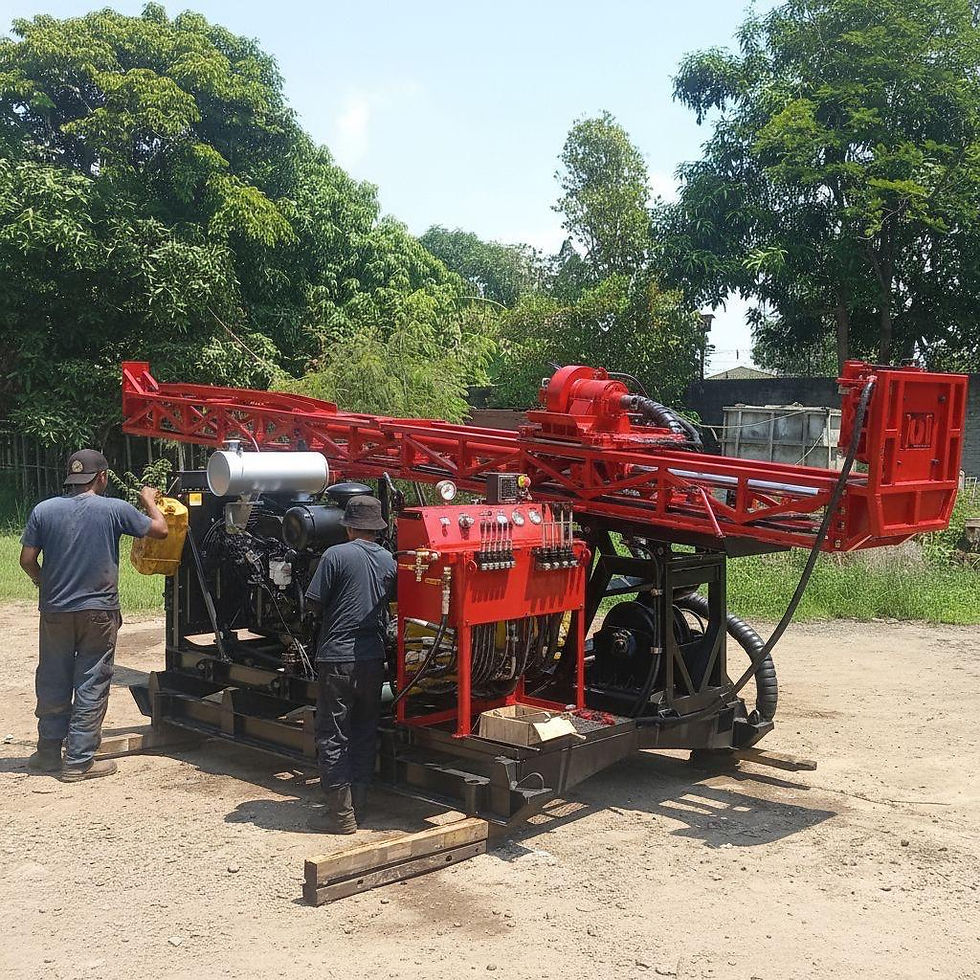
THE RIG IS ONLY THE START
CED talks about this constantly because field experience keeps proving it.
A Diamond Core rig by itself doesn't drill a metre.
You need the complete system.
CED can supply remote Diamond Core projects with:
Diamond drill rigs.
Drill rods.
Core barrels.
Inner tubes.
Diamond bits.
Reaming shells.
Casing systems.
Drilling muds and fluids.
Water and mud pumps.
Tooling.
Critical spare parts.
Experienced drillers.
Mechanical fitters.
Drilling supervisors.
Project support.
The further the project is from established infrastructure, the more important this becomes.
For a drilling project close to a major mining centre, forgetting a component can be irritating.
On a remote helicopter-supported drill site, forgetting a critical component can stop the operation.
Heli-Portable Drilling Is a Logistics Exercise
The helicopter gets plenty of attention.
But successful helicopter-supported diamond drilling is fundamentally about planning.
Every component matters.
Weight matters.
Dimensions matter.
Lift sequencing matters.
Fuel matters.
Water matters.
Pad design matters.
Consumable forecasting matters.
Maintenance planning matters.
And spare parts definitely matter.
The drilling equipment therefore needs to be considered as part of a complete mobilisation system rather than simply as a machine.
CED can work with clients to configure equipment around the logistical realities of the individual exploration project.
Man-Portable vs Heli-Portable Diamond Drilling
The two terms are often grouped together, but the actual mobilisation strategy can be very different.
Man-portable drilling generally prioritises smaller modules that can be physically moved through difficult terrain with limited mechanical assistance.
Heli-portable drilling allows larger individual modules to be transported by helicopter, depending on the aircraft, altitude, weather, fuel, payload restrictions and site conditions.
Some projects may use both.
Equipment can be flown into a general area and then broken down or repositioned around the immediate drill site.
The correct approach depends on terrain, drilling depth, helicopter capability, programme size and the amount of support equipment required.
There is no universal answer.
Build the drilling system around the project.
The Deeper the Hole, the More Important the Crew
A 100 m exploration hole and a 2,000 m Diamond Core hole are very different operations.
As drilling depth increases, experienced operators become increasingly valuable.
Drillers need to understand changing ground conditions, drilling parameters, mud systems, rod handling, hole stability, bit selection, equipment behaviour and preventative maintenance.
Small operational decisions made repeatedly over hundreds or thousands of metres can have enormous consequences.
That is why CED doesn't only manufacture equipment.
CED can also provide experienced Diamond Core drillers, supervisors and mechanical personnel to operate and support drilling programmes.
Because buying a capable rig and putting the wrong people behind the controls can be a very expensive experiment.
One Manufacturer. A Complete Remote Diamond Drilling Range.
This is the bigger story behind the CED Diamond Core range.
We're not trying to solve one depth.
We're trying to solve the remote drilling problem across multiple exploration stages.
From:
CED100 — approximately 100 m NQ
through a progressive family of increasingly capable Diamond Core rigs,
to:
CED2000 — approximately 2,000 m NQ.
The exploration target determines the equipment.
Not the other way around.
From Scout Drilling to Deep Exploration
That gives exploration companies an opportunity to build a logical drilling strategy.
A compact rig can support shallow reconnaissance.
Intermediate rigs can test increasingly developed targets.
Higher-capacity rigs can tackle deeper mineralised systems.
And the entire programme can be supported by CED consumables, drilling fluids, pumps, spares, operators and technical support.
100 metres or 2,000 metres.
Shallow scout drilling or deep exploration.
Man-portable or helicopter-supported mobilisation.
The objective remains exactly the same.
GET TO THE TARGET. GET THE CORE. KEEP DRILLING.
Planning a Remote Diamond Drilling Programme?
If you're planning mineral exploration somewhere where access is difficult, roads are limited or helicopter mobilisation is required, talk to CED before selecting the drilling equipment.
Tell us:
Where are you drilling?
What commodity are you exploring for?
What drilling depths are expected?
Which core sizes are required?
What does the terrain look like?
What helicopter capability is available?
How many metres are planned?
What support infrastructure exists?
From there, CED can look at the appropriate man-portable or heli-portable Diamond Core rig, together with the consumables, pumps, drilling fluids, spares and personnel required around it.
Because the question isn't simply:
How deep can the rig drill?
The first question is:
Can we get it to the target?
And the next one is:
Can we keep it drilling once it gets there?
What is the hardest mobilisation challenge you've encountered on a remote exploration drilling programme?

Comments