

UNDERGROUND DRILLING DOESN’T HAVE TO STAY UNDERGROUND.

Underground diamond drilling has an obvious problem.
The drilling happens underground.
But the equipment doesn't magically appear there.
Before the first core enters the barrel, somebody has to get the rig, rods, tooling, pumps, consumables, spare parts and people to the project.
Then equipment has to be moved around the operation.
Then eventually it has to move again.
For established underground mines with permanent infrastructure, workshops and dedicated equipment fleets, that process can be relatively straightforward.
For remote exploration projects, developing mines and operations spread across difficult terrain?
Not always.
That's the problem behind the CED SFM7500.
Take CED's underground diamond drilling capability.
Combine it with a highly mobile Toyota Land Cruiser 79 6x6 platform.
Build the supporting equipment around it.
And create a different way to think about underground drilling mobilisation.
Welcome back to Inside CED.
This week we're going underground.
But first, we're putting the underground rig on wheels.
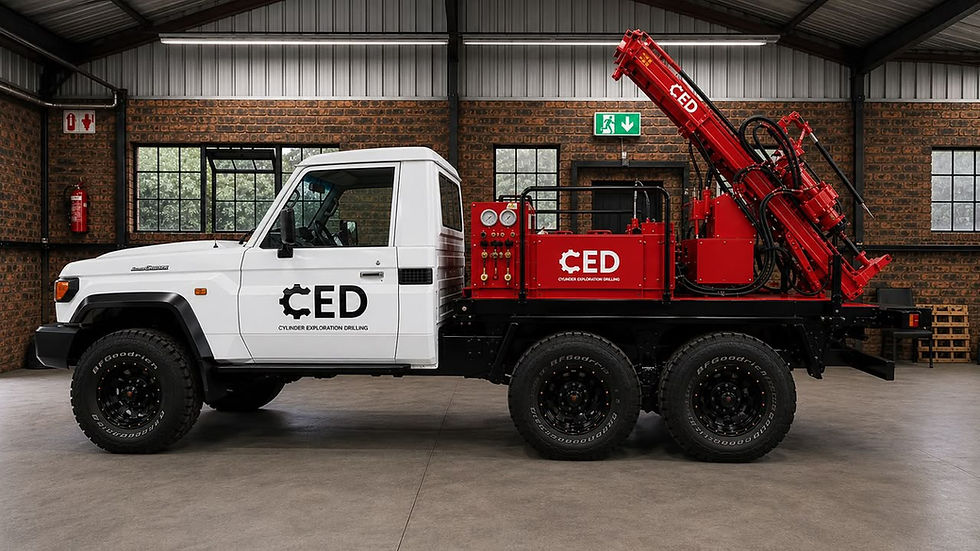
Underground Diamond Drilling: What Are We Actually Trying to Achieve?
The basic objective of underground diamond drilling isn't particularly complicated.
Recover high-quality core from beneath or around an underground mine development so geologists can better understand the orebody.
That information can support:
Resource definition
Infill drilling
Exploration around existing mineralisation
Geological interpretation
Mine planning
Orebody extensions
Structural understanding
Grade control and resource development
The drilling itself can be extremely technical.
But from an equipment perspective, underground drilling presents another challenge:
space.
Surface drill rigs have considerably more freedom.
Underground equipment has to work around drives, declines, headings, chambers and existing mine infrastructure.
That changes the engineering.
Why Underground Drill Rigs Are Different
An underground diamond drill doesn't simply need to drill.
It needs to fit.
That sounds obvious until you start looking at the operating environment.
Available width matters.
Height matters.
Machine footprint matters.
Rod handling matters.
Operator position matters.
Service access matters.
Ventilation matters.
Equipment movement matters.
Everything gets tighter underground.
A beautifully designed surface rig becomes considerably less beautiful when somebody discovers it doesn't fit through the access required to reach the drilling location.
That's why dedicated underground diamond drilling equipment exists.
The equipment needs to be engineered around the mine environment from the beginning.
So Why Put Underground Drilling Equipment on a 6x6?
Because the underground drill site is only part of the operation.
Equipment still needs to reach the mine.
It still needs to move between project areas.
It still needs consumables.
It still needs rods.
It still needs maintenance.
And the projects requiring underground exploration aren't always sitting beside a motorway.
The SFM7500 approaches the problem from a wider logistical perspective.
What if the transport platform became part of the drilling system?
The Toyota Land Cruiser 79 has earned its reputation across mining, exploration and remote operations because it can operate in places where conventional road vehicles quickly become unhappy.
CED's SFM programme takes that familiar platform and develops it into specialised exploration equipment.
For the SFM7500, the focus is underground drilling.
MOBILISE. DEPLOY. DRILL. MOVE. REPEAT.
That's really the SFM7500 concept in five words.
The objective isn't to claim that a Land Cruiser suddenly replaces every underground carrier, underground drill chamber or mine-specific mobilisation system.
It doesn't.
Every underground operation has different dimensions, infrastructure and access requirements.
The idea is more practical.
Use the 6x6 platform to make transporting and deploying underground drilling capability more flexible, particularly around remote projects and mine operations where mobility matters.
Get the equipment closer to where it needs to work.
Reduce unnecessary handling.
Support the drilling operation with equipment designed around the same mobile philosophy.
Then move again when the programme requires it.
The Rig Is Only One Part of Underground Drilling
Regular readers will know where this is going.
You can buy an excellent underground drilling rig and still have an incomplete drilling operation.
Because the rig needs a drill string.
The drill string needs bits.
The core barrel needs consumables.
The hole may need casing.
The drilling system needs water and pumping capacity.
Equipment needs spare parts.
The crew needs tooling.
And eventually something will wear out.
That's drilling.
So when CED discusses an underground diamond drilling package, we're interested in considerably more than the machine itself.
Depending on the project, the package can include:
Underground drill rig.
6x6 mobilisation platform.
Diamond drill rods.
Core barrels.
Diamond bits.
Reaming shells.
Casing and casing shoes.
Mud pumps.
Drilling fluids.
Tooling.
Critical spare parts.
Commissioning.
Training.
Drilling personnel.
Technical support.
Because a rig without the equipment required to keep it drilling is mostly an expensive piece of workshop furniture.

Underground Exploration Doesn't Stop at the Existing Orebody
One of the most important uses of underground diamond drilling is answering the next geological question.
What continues beyond the current development?
Does the mineralisation extend deeper?
Does it continue along strike?
What happens around the structure?
Can the resource be expanded?
Where should future development go?
Once underground access exists, drilling from underground can provide opportunities to test targets from positions that would be difficult or inefficient to reach entirely from surface.
That is why underground diamond drilling plays such an important role across established and developing mineral projects.
Gold.
Copper.
Nickel.
Zinc.
Lead.
Uranium.
Critical minerals.
Different commodities.
Same basic requirement:
More geological information.
And geological information still comes from metres drilled.
Mobility Becomes More Valuable When the Project Is Remote
Some of the world's most interesting mineral deposits have been inconsiderate enough not to form beside major cities.
Exploration teams operate across deserts, mountains, forests and enormous undeveloped areas.
Mine access may already be challenging before anyone even starts thinking about underground drilling.
This is where CED's wider SFM philosophy becomes relevant.
Rather than treating the drilling machine as an isolated piece of equipment, we're developing a mobile exploration ecosystem.
The drilling method changes.
The support requirement changes.
But mobility remains at the centre.
One SFM Platform Doesn't Need to Do Everything
This is important.
The objective of the SFM Series isn't to create one vehicle pretending to be every drilling rig on Earth.
That would be ridiculous.
Instead, different SFM platforms are designed around different jobs.
SFM7200 — Surface Diamond Drilling
For mobile surface diamond exploration.
SFM7300 — RC / Air Core / Auger
For shallow exploration and geochemical drilling programmes.
SFM7400 — Water Well Drilling
For remote water drilling and project water requirements.
SFM7500 — Underground Drilling
For mobile underground drilling capability.
SFM7600 — Exploration Support
For moving the supplies and support equipment exploration programmes actually consume.
SFMTS — Modular Support Trailers
For additional compressors, consumables, water, diesel, tooling and project equipment depending on configuration.
Different jobs.
One modular approach to exploration mobility.
Imagine the Fleet, Not Just the Rig
This is where things become more interesting.
A remote project might need surface diamond drilling first.
Another area may require RC or Air Core.
The camp needs water.
The drilling fleet needs fuel and consumables.
Underground development may eventually require dedicated drilling capability.
Traditionally, each requirement can become another completely separate equipment procurement exercise.
Different supplier.
Different vehicle.
Different spare parts discussion.
Different mobilisation.
Different headache.
CED is trying to look at that differently.
The SFM concept allows exploration companies to start thinking about a family of mobile platforms built around different drilling and support functions.
You don't necessarily need every vehicle.
You configure the system around the project.
Gold Mines and Underground Diamond Drilling
Gold is an obvious market for underground exploration drilling.
Many underground gold operations rely heavily on diamond drilling to improve geological confidence around existing mine development and investigate potential extensions to mineralisation.
That can mean significant drilling programmes operating continuously as the mine develops.
Reliability becomes critical.
Consumables become critical.
Spare parts become critical.
And experienced drill crews become extremely important.
For projects in developing mining jurisdictions, equipment support and supply chains can be just as important as the headline technical specification.
A rig capable of impressive numbers on paper isn't particularly useful if it spends its life waiting for one component.
Copper Doesn't Get Any Smaller Underground
Copper projects create another major opportunity for underground drilling.
As deposits become deeper and mining operations increasingly evaluate underground development, drilling remains fundamental to understanding the geometry, continuity and grade of mineralisation.
Large copper systems can require enormous quantities of drilling throughout exploration, development and production.
That creates demand not simply for rigs, but for complete drilling systems capable of operating reliably over long programmes.
Again:
The machine is only the beginning.
Design for the Fitter as Well as the Driller
Underground equipment has to be maintained.
There is no escaping that.
Hydraulic hoses eventually need attention.
Filters need replacing.
Seals wear.
Bearings wear.
Components need inspection.
Preventative maintenance needs doing.
Good drilling equipment design therefore needs to consider the person who eventually has to fix it.
Can components be accessed?
Can common service items be changed practically?
Are critical spares available?
Can the machine be supported locally?
These questions become even more important on remote mining projects.
CED's objective is to consider maintenance and support when the equipment package is being configured — not after the first breakdown.
Personnel Still Matter
You can manufacture an excellent underground drilling rig.
You can supply premium consumables.
You can provide every spare part imaginable.
Somebody still has to operate it.
And underground drilling requires competent people.
CED can support projects with experienced drilling personnel, supervisors and mechanical support alongside equipment supply.
We can also provide commissioning and training when new equipment arrives on site.
That means clients can discuss the machine and the people required to get it operating effectively as part of the same conversation.
Because handing over the keys and disappearing isn't much of a drilling strategy.
From Factory to Underground
The journey of an underground drilling system starts long before it reaches the mine.
Equipment needs to be manufactured.
Assembled.
Tested.
Prepared for freight.
Packed.
Exported.
Cleared.
Transported to site.
Commissioned.
Then operated.
CED can coordinate the wider process around international equipment supply, including rigs, consumables, spares and supporting equipment.
For clients operating internationally, consolidating that equipment before mobilisation can prevent a very familiar problem:
The rig arrived. The one thing we desperately need didn't.
That is not the phone call anybody wants.

The SFM7500 Is Really About Flexibility
The interesting part of the SFM7500 isn't simply that CED has combined underground drilling capability with a 6x6 platform.
It's what that combination represents.
Mobility.
Deployment flexibility.
A smaller logistical footprint.
Integration with the wider exploration fleet.
And the ability to build the supporting equipment around the actual drilling programme.
That's the direction CED is pushing with the SFM Series.
Not bigger equipment simply because bigger looks impressive.
Equipment designed around how exploration teams actually work.
Underground Drilling Doesn't Have to Be an Isolated Operation
Surface exploration and underground exploration are often discussed as completely different worlds.
Operationally, there are obvious differences.
But from the perspective of an exploration company, they are part of the same objective.
Understand the geology.
Define the resource.
Test the next target.
Keep drilling.
CED's equipment range is increasingly being built around that complete exploration cycle.
Surface diamond.
RC.
Air Core.
Water.
Underground.
Support.
Consumables.
Personnel.
Logistics.
One manufacturer. Multiple drilling environments. One objective: keep the exploration programme moving.
CED SFM7500: TAKE UNDERGROUND DRILLING FURTHER
The SFM7500 isn't about turning underground drilling into a road trip.
It's about recognising that mobility matters before, during and between drilling programmes.
For mining companies, exploration contractors and project developers looking at underground diamond drilling, the conversation shouldn't stop at depth capacity and rotation torque.
Ask how the equipment gets there.
Ask how it moves.
Ask what consumables it needs.
Ask what spares should travel with it.
Ask who will commission it.
Ask who will operate it.
And ask what happens when the project moves again.
Because underground drilling equipment still has to live in the real world.
Mobilise faster. Access difficult projects. Drill. Move. Repeat.
Cylinder Exploration Drilling manufactures and supplies underground drilling equipment, diamond drilling rigs, RC and Air Core systems, mobile SFM platforms, compressors, pumps, drilling consumables, spares and complete exploration packages for projects worldwide.
Planning an underground exploration programme or looking for your next underground diamond drilling rig?
Talk to CED about the SFM7500 and the complete drilling package behind it.
Over to the underground drillers
What's the biggest mobilisation or equipment challenge you've encountered when moving an underground drilling operation between projects?
Comments