

WATER ISN’T OPTIONAL. ACCESS SHOULDN’T BE EITHER.

There are plenty of things a remote exploration project can survive without.
Water isn't one of them.
People need it.
Drilling operations need it.
Camps need it.
Maintenance facilities need it.
And depending on the project, enormous quantities can be required to keep exploration and mining activities moving.
The problem?
Mineral exploration has a habit of happening in places where infrastructure is somewhere between limited and completely nonexistent.
So while finding water can be challenging enough, getting conventional water well drilling equipment to the location where that water is actually needed can become an entirely separate operation.
Large truck-mounted water drilling rigs work extremely well when the access works for them.
When it doesn't?
You need another approach.
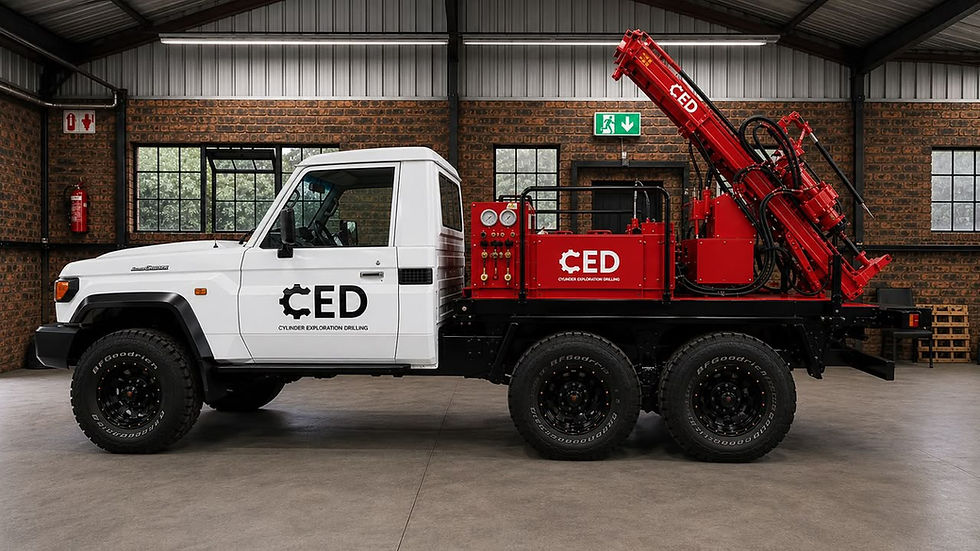
Enter the CED SFM7400
This week Inside CED, we're looking at why CED has developed a dedicated water well drilling system around a highly mobile 6x6 platform — and why water should be considered part of the wider exploration support system.

The Water Problem Nobody Talks About Until Mobilisation
When planning a mineral exploration programme, attention naturally goes towards the geology.
Where are the targets?
What drilling method are we using?
How many metres?
Diamond drilling?
RC?
Air Core?
Which rig?
Which compressor?
All sensible questions.
But somewhere in that planning document there needs to be another one:
Remote exploration camps need reliable water.
Diamond drilling operations can require significant water supplies.
Workshops and equipment maintenance need water.
People working in remote camps need clean water for everyday living.
Transporting that water continuously over large distances can become expensive and logistically difficult.
Where hydrogeological conditions allow it, drilling a suitable bore can potentially provide another option.
But that creates the next problem.
How do you get the water well rig there?
Meet the CED SFM7400
The CED SFM7400 is our dedicated mobile water well drilling platform within the wider SFM Series.
It is built around a heavy-duty Toyota Land Cruiser 79 6x6 platform developed for demanding off-road applications.
The thinking behind it is straightforward:
Take the water drilling capability closer to where the water is actually needed.
Rather than treating mobility as an afterthought, the vehicle and drilling system are developed as one integrated platform.
The 6x6 configuration provides an additional axle and six-wheel-drive layout for applications where off-road mobility and equipment carrying capacity matter.
But simply mounting drilling equipment onto a Land Cruiser isn't the clever part.
The challenge is integrating the drilling equipment, hydraulic systems, mast, controls, vehicle, weight distribution and supporting equipment into a practical mobile system.
Because ultimately this machine still needs to do a job.
It needs to drill for water.

Mining Camps Need Water Before They Need a Mine
Here's an interesting thing about mineral exploration.
You can be years away from producing a single tonne of ore and still need substantial infrastructure.
Geologists arrive.
Drillers arrive.
Support crews arrive.
Camps are established.
Equipment starts operating.
And all those people and machines require supplies.
For remote exploration projects, water availability can therefore influence everything from camp location to drilling logistics.
The SFM7400 is intended to provide another tool for projects that need to establish or investigate local groundwater supplies without automatically mobilising a much larger conventional water well drilling truck.
Potential applications include:
Mineral exploration camps
Remote mine sites
Exploration project water supply
Rural and agricultural water projects
Infrastructure programmes
Remote communities
Difficult-access drilling locations
Project support boreholes
The exact drilling configuration required will always depend on the geology, anticipated bore depth, hole diameter and project objectives.
That's an important point.
There is no universal water well rig for every bore on Earth.
The equipment needs to be matched to the job.
Why Put a Water Well Rig on a 6x6 Land Cruiser?
Because the water isn't always conveniently sitting beside a road.
Remote projects can involve sand, mud, steep tracks, rough ground, narrow access routes and considerable distances between operating locations.
Every additional heavy vehicle increases the mobilisation footprint.
The SFM concept asks a different question:
How much useful drilling capability can we put onto a smaller, highly mobile platform?
For suitable applications, that creates an interesting alternative to the traditional large water well truck.
A smaller vehicle footprint can potentially provide greater flexibility around exploration camps and remote project infrastructure.
It also means the vehicle carrying the drilling equipment is based on a platform already familiar across mining, exploration and remote operations around the world.
The Land Cruiser isn't there for decoration.
Mobility is part of the drilling system.
The SFM7400 Isn't Really About Water Wells
That sounds ridiculous, considering we've just spent several paragraphs discussing water well drilling.
But hear us out.
The bigger idea behind the SFM7400 is self-sufficient exploration.
This is why CED isn't developing the machine in isolation.
It's one part of the wider CED SFM Series.
The SFM7200 handles surface diamond drilling.
The SFM7300 tackles RC, Air Core and Auger applications.
The SFM7400 provides water well drilling capability.
The SFM7500 extends the concept towards underground drilling.
The SFM7600 provides mobile project support.
And the SFMTS trailer system allows additional equipment and supplies to move with the fleet.
Different machines.
Different jobs.
One underlying philosophy: mobility.
Imagine the Exploration Fleet Differently
Think about a remote exploration programme operating across a large concession.
One 6x6 platform is carrying the diamond drilling system.
Another is handling shallow RC or Air Core work.
A support vehicle is moving water, equipment and project supplies.
Trailers are carrying compressors, consumables or additional support equipment.
And where required, another mobile platform provides the capability to establish a water bore.
That is much closer to the SFM concept than simply selling someone a Land Cruiser with a drill bolted to the back.
It's a modular exploration fleet.
And that opens up some interesting possibilities for projects operating across large areas with limited infrastructure.
Africa: Where Mobility and Water Meet Exploration
Africa is an obvious application area for mobile water drilling equipment.
The continent hosts major gold, copper, lithium, uranium and critical-mineral exploration programmes, many operating far from established infrastructure.
But Africa isn't one environment.
A project in Ghana can present completely different access and water challenges from one in Namibia, Ethiopia, Mali or the Democratic Republic of Congo.
That means equipment selection needs to reflect the actual project.
For exploration companies operating across remote concessions, however, the combination of off-road mobility and water drilling capability can be particularly interesting.
The SFM7400 allows CED to discuss the water requirement alongside the rest of the exploration equipment package rather than treating it as an unrelated problem.

The Middle East: Water Becomes Even More Important
Move the conversation into the Middle East and water takes on another dimension.
Mineral exploration is expanding across parts of the region, including projects operating in extremely arid environments.
Water availability, transport and storage can become major operational considerations.
Again, the answer isn't automatically to drill a bore.
Groundwater conditions, permits, geology and project requirements all matter.
But where a bore is appropriate, having a mobile drilling platform capable of reaching remote locations creates another option for project planners.
The same principle applies across suitable projects in
.
The geography changes.
The need to get equipment to the target doesn't.
A Water Rig Still Needs a Support System
Here's something regular readers of Inside CED will recognise.
The rig is only part of the package.
A water well drilling operation requires more than a mast and rotation head.
Depending on the drilling method and project, there may be requirements for compressors, pumps, drill rods, bits, tooling, hoses, fluids, spare parts and additional support equipment.
Then somebody needs to transport it.
This is where CED's broader manufacturing and supply capability comes into the picture.
We can look at the SFM7400, supporting equipment, consumables, spare parts, commissioning, training and international logistics as parts of the same project.
And where the water well rig forms part of a larger mineral exploration programme, we can also discuss the equipment required for the actual exploration drilling.
Diamond.
RC.
Air Core.
Water.
Compressors.
Consumables.
Support equipment.
Instead of seven unrelated purchasing conversations, let's have one useful one.
Remote Drilling Is Ultimately
Remote Drilling Is Ultimately a Logistics Problem
You can build an extremely capable drilling rig.
But if you can't get it where it needs to drill, that capability doesn't mean much.
That principle sits behind much of what we're doing with the SFM Series.
The SFM7400 isn't designed to replace every conventional truck-mounted water well rig.
It doesn't need to.
It is designed to provide a highly mobile water well drilling option for projects where access, mobilisation and operational flexibility matter.
And in remote exploration, they usually matter a lot.
The objective is simple:
Get the drilling equipment closer to the job.
Reduce unnecessary mobilisation headaches.
Give exploration teams more options.
And where suitable groundwater is available, help projects establish water supplies closer to where they are actually operating
.
One Vehicle Is Useful. A Mobile System Is Better.
This is where the SFM Series starts becoming much more interesting.
The SFM7400 can operate as a dedicated water well drilling platform.
But put it alongside the rest of the CED SFM fleet and you start building something much bigger.
SFM7200 — Surface Diamond Drilling
SFM7300 — RC / Air Core / Auger Drilling
SFM7400 — Water Well Drilling
SFM7500 — Underground Drilling
SFM7600 — Exploration Support Vehicle
SFMTS — Modular Support Trailers
Add CED compressors, pumps, drilling consumables, rods, tooling, spare parts and field support and the concept becomes a mobile exploration ecosystem rather than a collection of individual machines.
That is where we believe the real opportunity sits.
Exploration companies shouldn't necessarily have to build their operations around the limitations of their equipment.
The equipment should be built around the realities of exploration.
Built for Projects That Don't Have a Convenient Address
The easiest drilling projects aren't normally the ones that create the biggest equipment challenges.
It's the projects hundreds of kilometres from major infrastructure.
The projects where the road disappears.
The projects where getting fuel, water, drilling consumables and spare parts to site requires serious planning.
The projects where moving a conventional drilling fleet can become almost as complicated as the drilling itself.
Those are exactly the environments that make us question how exploration equipment should be designed.
And that is what the SFM programme is about.
Not making machines bigger for the sake of making them bigger.
Making equipment more useful, more mobile and easier to integrate into a complete exploration operation.
From Water Well Rig to Complete Exploration Package
CED manufactures and supplies considerably more than the SFM7400.
For companies establishing new exploration programmes, we can build packages around the drilling methods and support equipment actually required.
That can include:
Diamond drilling rigs.
RC drilling rigs.
Air Core drilling rigs.
Water well drilling equipment.
Air compressors.
Mud pumps.
Drill rods and tooling.
Drilling consumables.
Muds and drilling fluids.
Spare parts.
SFM support vehicles and trailers.
International freight and mobilisation.
Commissioning and training.
Drilling personnel and operational support.
The objective isn't to sell the longest equipment list possible.
It is to make sure the equipment arriving on site actually works together.
Because finding out you're missing one critical component after everything has travelled halfway around the world is a particularly expensive way to discover the importance of planning.
The CED SFM7400
Water isn't the glamorous side of mineral exploration.
Nobody gets particularly excited about the water supply when the geological team is discussing a new target.
Until there isn't enough water.
Then suddenly everybody is extremely interested in water.
That is why we believe water drilling deserves a place within the wider exploration equipment conversation.
The CED SFM7400 brings dedicated water well drilling capability onto the same highly mobile 6x6 philosophy being developed across the SFM Series.
For mining companies, exploration contractors, water drilling companies and project developers operating in remote or difficult-access environments, that creates another way of approaching the problem.
Don't just ask how deep the rig can drill.
Ask how you're going to get the rig there.
Ask what else needs to travel with it.
Ask where your water is coming from.
And ask whether your entire exploration fleet could be working together more efficiently.
That's the thinking behind the SFM7400.
Water where you need it. Drilling equipment that can actually get there.
Cylinder Exploration Drilling supplies drilling rigs, compressors, consumables, support equipment and complete exploration packages for projects worldwide.
If you're planning a remote water drilling programme, establishing a new exploration camp or looking for a 6x6 water well drilling rig, talk to CED about the complete requirement.
One project. One coordinated equipment package. Built around where you actually need to work.
What do you think?
For remote mining and exploration projects, how much value could a highly mobile water well drilling platform add compared with relying entirely on conventional heavy truck-mounted equipment?
Comments