

The New Scramble for African Copper: Why Zambia Is Back at the Centre of Global Mining

The global race for copper is moving into Africa.
Electric vehicles need it.
Power grids need it.
Renewable energy needs it.
Data centres and AI infrastructure need it.
Defence, construction and advanced manufacturing need it.
But while governments around the world talk about securing future copper supply, there is one fundamental problem:
You cannot secure copper that has not yet been discovered, defined and developed.
That is putting mineral-rich countries back at the centre of global economic strategy.
And few countries are attracting as much attention as Zambia.

Zambia Is Back on the Global Mining Radar
Zambia is not a new copper jurisdiction.
Mining has shaped the country's economy for generations, and the Zambian Copperbelt forms part of one of the most important copper-producing regions on Earth.
What is changing is the level of international attention.
Governments, mining companies and investors are increasingly looking beyond simply buying copper on international markets.
They want access to the resources themselves.
That makes countries with established copper geology enormously important.
Zambia has the geology.
It has a long mining history.
And crucially, significant exploration potential remains.
Why the World Is Competing for Copper
Copper has moved far beyond being simply another industrial commodity.
It is becoming a strategic material.
The global economy is attempting to expand electricity generation and transmission while simultaneously building electric vehicles, renewable energy projects, battery infrastructure and enormous new data centres.
All of this requires physical infrastructure.
And physical infrastructure requires raw materials.
Copper sits at the centre of much of it.
The problem is that building demand can happen much faster than building mines.
A technology company can announce another data centre.
A government can approve a new transmission network.
An automotive company can expand electric vehicle production.
But a major new copper mine can take years—or decades—from discovery to production.
That creates a race to find the deposits required for the future.
Africa Holds Part of the Answer
Africa contains some of the world's most extraordinary mineral endowment.
Copper.
Cobalt.
Gold.
Lithium.
Nickel.
Manganese.
Rare earth elements.
Yet large parts of the continent remain underexplored compared with mature mining jurisdictions.
That creates enormous opportunity.
The next generation of African mining will not only come from expanding existing operations.
It will also come from new discoveries.
And those discoveries require exploration.
Zambia's Copperbelt Is Only Part of the Story
When people think about Zambian copper, they naturally think about the Copperbelt.
But modern exploration is increasingly looking beyond historically mined areas.
New geological interpretation, geophysics and exploration technology allow companies to investigate targets that previous generations may have overlooked.
Mineralisation may be:
Deeper than historical drilling
Hidden beneath cover
Located away from existing mining centres
Structurally more complex
Part of larger systems not previously understood
This is why mature mining jurisdictions can still produce major discoveries.
The geology has not changed.
Our ability to find it has.

First Comes Geology. Then Comes Drilling.
Modern exploration can use extraordinarily sophisticated technology.
Satellite imagery can identify geological features across huge areas.
Geophysical surveys can detect anomalies beneath the surface.
Geochemical sampling can highlight prospective mineral systems.
Three-dimensional modelling can help geologists build increasingly sophisticated interpretations of what may exist underground.
But eventually every exploration programme reaches the same point.
There is a target on the screen.
There is a geological theory.
And somebody has to test it.
That means drilling.
Diamond Drilling Will Be Critical
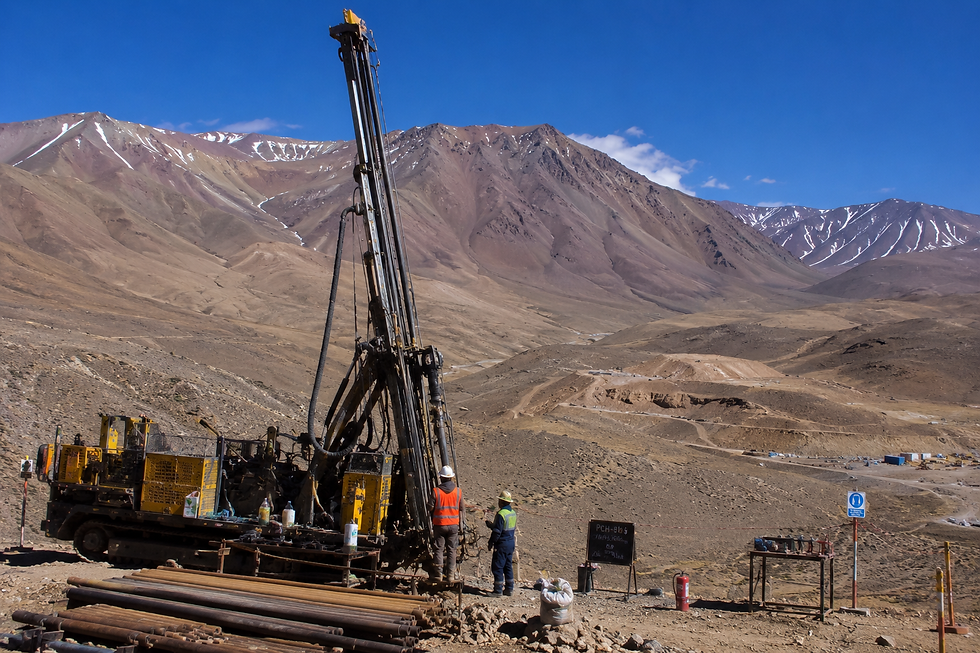
Diamond drilling remains one of the most valuable tools available to copper explorers.
It provides continuous rock core from beneath the surface.
That core allows geologists to physically examine the geology and understand:
Mineralisation
Alteration
Veining
Structural controls
Rock quality
Deposit continuity
Geotechnical conditions
Samples can then be assayed to determine copper and associated mineral grades.
As targets become deeper, drilling becomes increasingly demanding.
Hole stability becomes more important.
Water management becomes more important.
Drilling fluids become more important.
Equipment capacity becomes more important.
And experienced personnel become absolutely critical.
RC and Air Core Have Their Place Too
Not every exploration target needs to begin with deep diamond drilling.
Reverse circulation drilling can rapidly test geological targets and provide rock-chip samples.
Air core drilling can be extremely effective for shallow regional exploration and geochemical programmes.
A large exploration campaign may therefore involve several drilling methods.
Air core to identify.
RC to test.
Diamond drilling to understand and define.
The correct drilling method depends on the geology, depth, ground conditions and objectives of the programme.
Africa's Exploration Challenge Is Often Logistics
A mineral deposit does not choose to exist beside a highway.
Some of the world's most interesting exploration targets are in difficult locations.
Road access may be poor.
Water may be limited.
Fuel may need to travel hundreds of kilometres.
Spare parts may need to cross international borders.
Drilling consumables need to arrive before they are required.
Mechanical support needs to be available when something fails.
And crews need to operate safely for extended periods in remote environments.
That means exploration drilling in Africa is as much a logistics operation as it is a drilling operation.
A $500 Part Can Stop a Multimillion-Dollar Programme
Remote drilling teaches an important lesson very quickly:
The value of a component is not necessarily its purchase price.
A relatively inexpensive starter motor, hydraulic component, bearing, seal or fitting can stop an entire drilling operation if no replacement is available.
The rig stops.
The drill crew stops.
Geologists wait.
Support personnel wait.
Production disappears.
This is why critical-spares planning is fundamental to remote exploration.
Experienced contractors do not only ask:
"What normally fails?"
They ask:
"What could stop us drilling if it fails?"
There is an important difference.
Preventative Maintenance Is Production
Maintenance is sometimes viewed as time when a rig is not drilling.
That is the wrong way to look at it.
Preventative maintenance protects future production.
Regular servicing allows crews to identify wear before it becomes failure.
Filters are changed.
Fluids are checked.
Hydraulic systems are inspected.
Bolts and fittings are checked.
Engines are serviced.
Drilling equipment is inspected.
Small problems are addressed before they become large ones.
In remote exploration, this can be the difference between several hours of maintenance and several days of downtime.
Experienced Crews Still Matter
Drilling equipment continues to improve.
Technology continues to improve.
Automation continues to improve.
But exploration drilling remains an industry where experience matters enormously.
Ground conditions change.
Water conditions change.
Formations collapse.
Rods become stuck.
Drilling parameters need adjusting.
Sometimes production needs to slow down to protect the hole.
An experienced driller understands that the objective is not simply to make the rig turn faster.
The objective is to safely reach the geological target while recovering the information the client needs.

More Metres Do Not Always Mean Better Drilling
Metres drilled are important.
But metres alone should never define the success of an exploration programme.
A contractor also needs to consider:
Core recovery
Hole stability
Safety
Equipment condition
Consumable usage
Downtime
Geological requirements
Final hole depth
Twenty metres successfully drilled through extremely difficult ground may represent a better operational result than forty metres drilled aggressively while damaging equipment or compromising the hole.
Good drilling is about sustainable production.
Zambia Could Become Part of a Much Bigger African Mining Cycle
The renewed attention on Zambia represents something larger.
Governments around the world increasingly recognise that critical mineral supply is a strategic issue.
That will direct more capital toward countries capable of supplying copper and other essential minerals.
Africa is exceptionally well positioned.
But converting geological potential into mines requires an enormous amount of work.
Exploration licences need to be awarded.
Capital needs to be raised.
Targets need to be generated.
Roads need to be built.
Camps need to be established.
And eventually drilling rigs need to start turning.
Exploration Investment Creates Opportunity Beyond the Mine
A major exploration cycle creates an entire supporting economy.
Projects require:
Drilling contractors
Equipment manufacturers
Geological services
Logistics providers
Mechanical support
Consumables
Drilling fluids
Transport
Camps
Local employees
Training
This is why increasing exploration investment can have an impact long before a mine reaches production.
The exploration phase itself creates economic activity.
CED's African Approach
At Cylinder Exploration Drilling (CED), Africa is a major part of our long-term strategy.
Our approach combines drilling equipment with the people and support required to operate it.
CED capabilities include:
Diamond drilling
Reverse circulation drilling
Air core drilling
Remote-access drilling
Drilling rigs
Compressors
Drilling consumables
Drilling muds
Critical spare parts
Experienced drillers
Mechanical fitters
Supervisors
Complete drilling programme management
We believe this integrated approach is particularly important for remote and developing exploration markets.
A client should not simply receive a drill rig.
They should have access to the support required to keep that rig producing.
The Competition for African Minerals Is Only Beginning
Copper demand is not disappearing.
Neither is demand for gold, lithium, cobalt, nickel and other critical minerals.
Countries that once relied entirely on international commodity markets are increasingly trying to secure direct access to supply.
That means mineral-rich African nations are gaining strategic importance.
But geology alone will not create the next mining boom.
Investment needs to reach the ground.
Exploration programmes need to happen.
And drilling needs to convert geological potential into proven resources.
Final Thought
The new global competition for copper is not simply a race to buy metal.
It is becoming a race to find it.
Zambia sits on one of the world's great copper regions and is once again attracting international attention.
But the bigger story stretches across Africa.
Large areas remain underexplored.
New technology is generating new targets.
International capital is looking for future supply.
And the world needs new discoveries.
That creates an enormous opportunity for mineral exploration.
Because before the investment announcement, before the processing plant and long before the first shipment of copper leaves the mine—
someone has to drill the ground and prove what is there.


Comments