

The World Is Coming for Africa’s Critical Minerals — But First, Someone Has to Find Them

Something is changing in African mining.
Quietly at first.
Now considerably less quietly.
Governments, mining companies, investors and manufacturers are looking at Africa with renewed urgency.
Not simply for gold.
Not simply for copper.
They are looking for critical minerals.
Rare earths.
Niobium.
Lithium.
Cobalt.
Copper.
Manganese.
Graphite.
Nickel.
Tantalum.
The minerals sitting behind electrification, defence, data centres, renewable energy, advanced manufacturing and the global race for technological dominance.
And September 2026 has provided another reminder of just how quickly that race is accelerating.
The United States has pledged support for Kenya's ambitions to develop its critical-minerals industry.
The Democratic Republic of Congo is strengthening control over its geological data while undertaking a huge geological mapping programme.
Zambia continues attracting international attention and producing new exploration results.
Across the continent, countries are asking a bigger question:
If Africa holds many of the minerals the world desperately wants, why shouldn't Africa capture more of their value?
It could become one of the defining mining stories of the next decade.
But there is a problem.
Before anyone can process critical minerals...
Before anyone can build a mine...
Before governments can secure supply...
Someone has to find them.
And that means exploration.

The Critical Minerals Race Has Moved Into Africa
Critical minerals have become geopolitical.
That is the big shift.
Mining was once discussed primarily in terms of commodities, grades, production costs and commodity cycles.
Those things still matter.
But governments now talk about mineral supply in the same conversations as national security, energy security, manufacturing and technological independence.
The United States wants more diversified supply.
Europe wants more diversified supply.
India wants more diversified supply.
China already occupies enormously important positions across numerous mineral supply chains.
Everybody wants security.
And Africa sits in the middle of the conversation.
The continent contains extraordinary geological potential across multiple commodities.
That makes it impossible to ignore.
Kenya Is Suddenly Part of the Conversation
Kenya is not usually the first country people mention when discussing global mining powerhouses.
That could be exactly why its emerging critical-minerals story is interesting.
In September, the United States said it would support Kenya in developing its critical-minerals processing industry.
Particular attention has fallen on Mrima Hill, a mineralised area associated with rare earth elements and niobium.
Those are not household commodities.
But they are increasingly important ones.
Niobium is used in high-strength steels and specialist alloys.
Rare earth elements are essential across technologies including permanent magnets, electronics, electric motors, defence systems and renewable-energy infrastructure.
Suddenly a mineral occurrence on the Kenyan coast becomes part of a much larger geopolitical story.
And Kenya is unlikely to be the last African country to experience that change.
The DRC Wants to Know Exactly What It Owns
Move west and another fascinating story is developing.
The Democratic Republic of Congo is already one of the most important mining jurisdictions on Earth.
Its copper and cobalt industries are globally significant.
But only around 20% of the country has been systematically explored.
That number is extraordinary.
Congo is now pushing forward with a major geological mapping programme and the development of a national geological databank.
Why?
Because geological information has value.
If you understand what lies beneath your country, you are in a considerably stronger position when negotiating with mining companies, investors and foreign governments.
But better mapping has another consequence.
It creates exploration targets.
An airborne survey might identify a magnetic anomaly.
Geochemistry might reveal an unusual mineral signature.
Historical geological information might suddenly make sense when combined with modern datasets.
Then geologists start asking questions.
Could something be underneath it?
How large could it be?
How deep?
Is it mineralised?
There is eventually only one way to answer those questions.
Drill it.
Zambia Is Still Showing Why Drilling Matters
Last Sunday we looked at Zambia and the renewed global scramble for African copper.
Since then, the exploration story has kept moving.
Fresh drilling results from Zambia's Mushima North Project have reported broad near-surface silver-copper-zinc mineralisation, including intervals where holes ended while still within mineralisation.
That is exploration happening in real time.
A target is identified.
A drill programme tests it.
Results come back.
The geological model changes.
Then somebody decides where to drill next.
This is what gets lost when people discuss global mineral shortages.
A mine does not suddenly appear because copper, lithium or rare-earth prices increase.
It begins with thousands of decisions made during exploration.
And many of those decisions are based on what comes out of a drill hole.
Africa's Advantage Is Geology
Africa is not suddenly becoming mineral rich.
It always was.
The difference is that the world is paying more attention.
The continent hosts some of the planet's most important mineral provinces.
The Central African Copperbelt.
The West African Birimian gold belts.
The Zimbabwe Craton.
The Bushveld Complex.
The Arabian-Nubian Shield extending into northeast Africa.
Major pegmatite provinces.
Rare-earth systems.
Graphite deposits.
Manganese districts.
And huge areas where modern systematic exploration remains limited.
That last point matters.
Mature mining jurisdictions have often experienced decades—or more than a century—of intensive exploration.
Large areas of Africa have not.
That does not guarantee discoveries.
Exploration never comes with guarantees.
But it does mean there is still a lot of geological ground to test.

The Next Major Discovery Might Be Under Cover
The easy deposits tend to get found first.
Outcropping mineralisation is obvious.
Old workings provide clues.
Visible alteration can lead explorers toward targets.
But exploration becomes more difficult as the obvious targets disappear.
The next generation of discoveries may be:
Deeper.
Under transported cover.
Hidden beneath vegetation.
Away from existing mining districts.
In areas previously considered too difficult to access.
That changes the exploration equation.
Better geophysics becomes important.
Better geological modelling becomes important.
Geochemistry becomes important.
AI and large geological datasets may become increasingly useful.
But ultimately the physical test remains the same.
You need to put a hole into the ground.
Air Core: Finding the Signal
Large exploration licences create a simple problem.
Where do you start?
You cannot diamond drill every square kilometre.
Air Core drilling can provide a highly effective first-pass exploration method in suitable ground conditions.
It is relatively fast and can allow explorers to test beneath shallow cover across large areas.
That makes it particularly useful for regional geochemical programmes.
Instead of immediately trying to define a deposit, Air Core can help answer the earlier question:
Where should we look harder?
That distinction can save enormous amounts of exploration capital.
RC: Testing the Target
Once targets become more focused, Reverse Circulation drilling can take over.
RC drilling is fast.
It can reach meaningful depths.
And it provides rock-chip samples that can be analysed for mineralisation.
For many gold, copper and critical-mineral programmes, RC becomes one of the workhorses of exploration.
A geophysical anomaly that looked interesting from the surface suddenly has actual rock samples attached to it.
Some targets die.
That is normal.
Others get considerably more interesting.
Those are the ones that keep the drill rigs moving.
Diamond Drilling: Understanding What Is Actually There
Eventually explorers need detail.
That is where diamond drilling becomes incredibly valuable.
Continuous core gives geologists something completely different.
They can physically examine the rock.
Mineralisation.
Structures.
Veins.
Alteration.
Contacts.
Fractures.
Rock quality.
Orientation.
The geological system becomes visible.
Core can be logged, photographed, cut, sampled and assayed.
That information helps geologists build increasingly sophisticated three-dimensional models of a deposit.
And those models ultimately influence decisions involving millions—or billions—of dollars.
It all begins with a cylinder of rock coming out of the ground.
But Africa Has Another Challenge: Getting There
Finding a target is only half the battle.
This is where exploration becomes operational.
Mineral deposits have an irritating habit of not occurring beside paved roads.
Some of Africa's most prospective areas are remote.
Very remote.
Access can involve poor roads, seasonal tracks, mountains, forests, deserts or areas with little existing infrastructure.
That creates a completely different engineering problem.
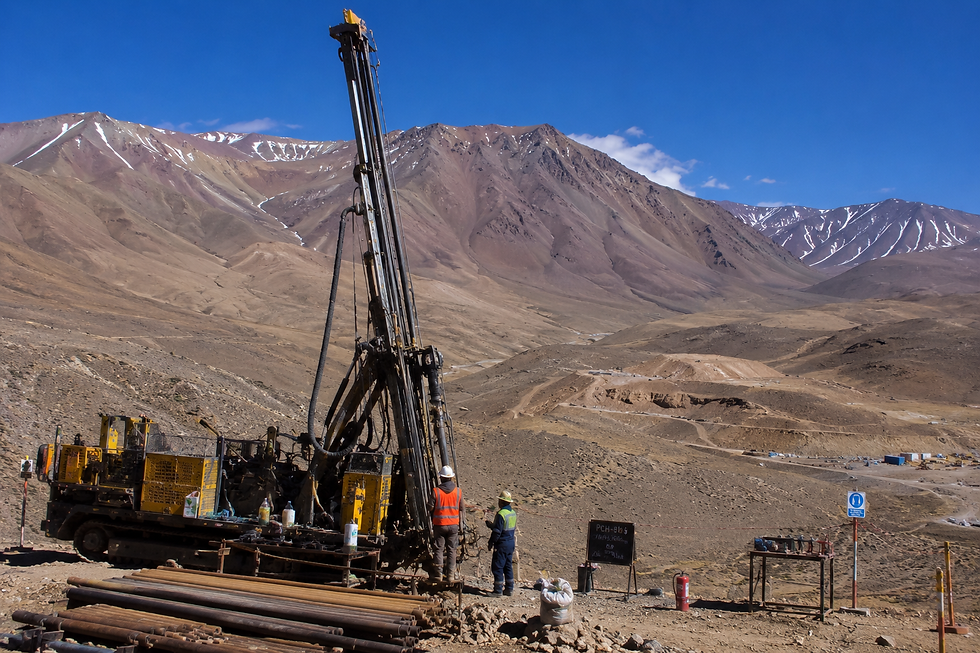
How do you get the drill rig to the geology?
A 30-tonne machine with enormous capability is useless if the bridge into the project can only handle ten tonnes.
A powerful truck-mounted rig is useless if there is no road.
A drilling programme designed around perfect infrastructure can collapse when confronted by reality.
Remote exploration therefore requires equipment designed around access.
Track-mounted rigs.
Compact rigs.
Man-portable rigs.
Highly mobile vehicle platforms.
Modular equipment.
In extreme situations, heli-portable drilling systems.
The geology chooses the location.
The drilling operation has to adapt.
The Drill Rig Is Only One Part of the Programme
This is something we talk about constantly at CED.
People naturally focus on the rig.
It is the big piece of machinery.
It drills the hole.
But a drill rig on its own achieves very little.
A remote drilling programme may also require:
Drill rods
Core barrels
Bits
Casings
Compressors
Mud pumps
Water pumps
Drilling fluids
Fuel
Generators
Tools
Critical spare parts
Support vehicles
Experienced drillers
Mechanical fitters
Supervisors
Logistics
Miss one critical component and an expensive drilling operation can stop.
That is why we increasingly look at exploration as a complete operating system rather than simply an equipment sale.
Critical Spares Become Very Important Very Quickly
Remote exploration has a wonderful ability to make a cheap spare part extremely expensive.
Not because the component itself changes value.
Because downtime does.
Imagine an exploration camp.
The rig is there.
The drill crew is there.
Geologists are there.
Vehicles are there.
Accommodation is running.
Fuel is being consumed.
Everything is ready.
Then one relatively small component fails.
And there isn't another one on site.
Suddenly a small spare part is holding an entire exploration programme hostage.
This is why critical-spares planning matters.
Do not simply ask which parts are expensive.
Ask:
Which parts can stop the programme?
Those are the components worth carrying.
Africa Needs More Than Foreign Equipment
If this new critical-minerals cycle genuinely accelerates, Africa does not simply need more imported machines.
It needs capability.
Training.
Local drill crews.
Mechanical knowledge.
Supply chains.
Consumable availability.
Equipment support.
Geological expertise.
Maintenance infrastructure.
Local partnerships.
That is how an exploration boom becomes an industry rather than a temporary rush.
And it is also where international companies need to think differently.
Dropping equipment at a port and disappearing is not enough.
A drilling rig needs to operate.
Operators need training.
Spare parts need supplying.
Consumables need replenishing.
Problems need solving.
That requires long-term support.
CED's Role in African Exploration
At Cylinder Exploration Drilling (CED), Africa is central to where we see exploration going.
CED supports exploration companies and drilling contractors with:
Diamond drilling rigs
RC drilling rigs
Air Core drilling rigs
Man-portable drilling systems
Mobile drilling platforms
Air compressors
Mud pumps
Drilling consumables
Drilling fluids
Spare parts
Drill crews
Mechanical support
Supervisors
Complete drilling programme support
But the bigger philosophy is simple.
Match the drilling system to the exploration problem.
If access is difficult, solve access.
If logistics are difficult, solve logistics.
If local drilling experience is limited, provide training and experienced personnel.
If downtime risk is high, build the correct spares package.
The objective is not simply to deliver machinery.
It is to get holes drilled.
Africa Has an Opportunity to Do Things Differently
There is another side to the critical-minerals story.
African countries increasingly want more than raw material extraction.
They want processing.
Jobs.
Training.
Infrastructure.
Local supply chains.
Technology transfer.
And greater participation in the value generated by their mineral resources.
That is understandable.
The coming critical-minerals boom therefore may not look exactly like previous mining cycles.
Governments are becoming more strategic.
They know mineral security matters to major economies.
That creates negotiating power.
Countries able to combine strong geology with stable investment conditions, infrastructure and sensible mining policies could attract enormous amounts of exploration capital.

The Map Is Changing
Look at what has happened in just the last few weeks.
Zambia is attracting renewed international attention around copper and critical minerals.
The DRC is investing heavily in understanding and controlling its geological information.
Kenya is discussing international cooperation around critical-mineral development.
Exploration programmes continue producing new mineralised intersections.
Governments outside Africa are trying to secure future mineral supply.
These are not isolated stories.
They are pieces of the same puzzle.
The world needs more minerals.
Africa has enormous geological potential.
And the race to understand that potential is accelerating.
But There Is No Shortcut to Discovery
Governments can sign critical-mineral agreements.
Investors can raise money.
Geologists can analyse datasets.
AI can generate targets.
Geophysics can identify anomalies.
Politicians can announce billion-dollar strategies.
But none of those things magically creates a mine.
Somewhere along the line, somebody has to go into the field.
A drilling pad has to be prepared.
A rig has to be mobilised.
Drill rods have to go into the ground.
Samples have to come back out.
Most targets will not become mines.
Some will fail completely.
Some will produce enough encouragement for another hole.
And occasionally one drill programme changes everything.
That is exploration.
The Real African Mining Boom May Still Be Ahead
Africa is already a mining continent.
But that does not mean its biggest discoveries are behind it.
Quite possibly the opposite.
Modern geological datasets are improving.
Exploration technology is improving.
Access to information is improving.
Global demand for critical minerals is growing.
And geopolitical competition is directing attention toward countries that possess the resources the world needs.
That combination could create a major new exploration cycle.
Not just in Zambia.
Not just in Congo.
Not just in Kenya.
Across Africa.
The interesting question is no longer simply:
What minerals does Africa already produce?
It is:
What haven't we found yet?
Because before the processing plant...
Before the railway...
Before the billion-dollar mine...
Before the first shipment of critical minerals leaves Africa...
There has to be a discovery.
And someone has to drill it.
The Question
With global competition for critical minerals accelerating and enormous areas of Africa still underexplored, which African country do you think will produce the next world-class mineral discovery?


Comments